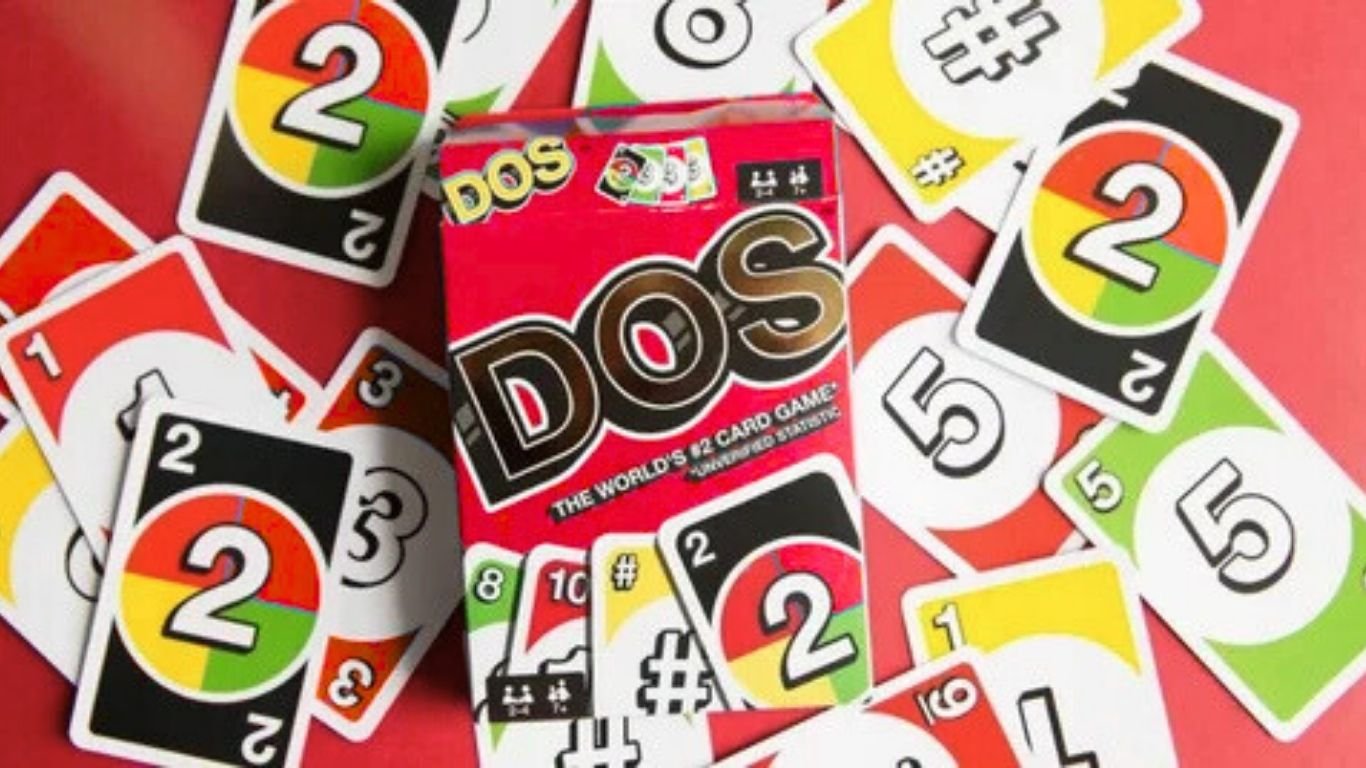
If you thought Uno had already done enough damage to your friendships, buckle up, because the Dos card game has slid onto the table with a smug little grin. It’s marketed as Uno’s “sequel,” but anyone who’s played it knows this game has its own agenda: new rules, new twists, and yes, double the drama.
Maybe you heard about it on TikTok, maybe a cousin pulled it out at Thanksgiving, or maybe it caught your eye at Target with that bold blue box promising “a new matching game experience.” Whatever brought you here, welcome to the growing club of curious players wondering whether Dos is a total upgrade… or a recipe for chaos.
Either way, you’re in good company, Dos has been quietly gaining a cult following, popping up in family game nights, college dorms, and viral clips faster than the internet can yell “Reverse!”
🎴 Quick Game Fact Box
| Feature | Details |
|---|---|
| Name | Dos (The Card Game) |
| Released By | Mattel (makers of Uno) |
| Launched | 2018 |
| Gameplay Style | Number-matching, fast-paced strategy |
| Players | 2–8 |
| Play Time | 20–40 minutes |
| Known For | Being the “Uno sequel,” introducing dual matching rows, and doubling the chaos |
| Official Sources | Mattel.com, BoardGameGeek |
What Is the Dos Card Game, Really?
Let’s break it down without sounding like a dusty rulebook.
The Dos card game is Mattel’s attempt to reinvent the Uno universe without losing the colorful, easy-to-learn charm that made Uno a global obsession. While Uno is all about matching colors and destroying your uncle with a “Draw Four,” Dos shifts the spotlight to numbers — matching them, stacking them, doubling them, and sometimes forgetting simple math under pressure because you’re panicking.
The game is built around two central piles, think of them like sibling rivals, always competing for attention. Your goal? Get rid of all your cards. Sounds simple enough, right? Well… hold that thought.
People often assume Dos is just Uno with a rebrand. Nope. This is a full-on remix. According to Mattel’s official rule set, Dos introduces multi-number plays and matching mechanics that reward clever planning over pure luck. It’s strategic without being intimidating, competitive without turning the room into a battlefield (allegedly).
And maybe that’s why it’s trending again in 2025! it has the familiar comfort of Uno without the trauma.
How to Play the Dos Card Game (A Quick, Sanity-Friendly Breakdown)
If you’ve ever tried learning a new card game from the official instructions and ended up Googling “Dos rules explained like I’m five,” you’re not alone.
Here’s the clean, human version:
Setup & Deck Basics
The Dos deck includes colored number cards (blue, red, yellow, green) and Wild Dos cards. At the start, every player gets seven cards. The table begins with two cards face-up, your “center row.”
These two cards will determine your fate for the next few rounds.
The Main Objective
Dump. Your. Cards.
That’s it. That’s the mission.
You win the round by emptying your hand and shouting “Dos!” before your last card hits the table, yes, there’s a shouting element too, because Mattel knows exactly how to trigger childhood nostalgia.
Matching Numbers, Adding Numbers, and Scoring
Here’s where Dos flexes its uniqueness:
- Match your card’s number to a card in the center row
- Or match two of your cards whose numbers add up to a center card
- Matching colors earns bonus moves
- Getting the math wrong earns side-eye
This adds a layer of logic Uno never asked you to use. Suddenly, Dos becomes a strategy puzzle disguised as a family game. BoardGameGeek reviewers often describe it as “Uno with algebra lite,” but don’t worry, you won’t need a calculator.
What Makes Dos Different From Uno?
Three things:
- Numbers > Colors
You’re doing basic math more often than you’d expect in a casual game. - Two active piles
Decisions feel more tactical because you’re juggling options. - Point scoring matters
In Uno, the ending is pure vibes. In Dos, every card left in your hand feeds your opponent’s score like breadcrumbs leading to victory.
It’s still easy, still chaotic, and still a vibe, just a more strategic one.
How Many Players Can Join the Madness?
Dos works beautifully for 2 to 8 players, but the sweet spot is 3–5. With fewer players, the game becomes brainy and calm. With more players, it becomes unhinged, in the best way.
Families love it because kids can grasp the rules fast. College students love it because competition gets spicy. And adults love it because it’s a step above Uno without requiring therapy after a Draw Four situation.
Is Dos Harder or Easier Than Uno?
Ah yes, the question that sparks heated Reddit debates and TikTok rants.
The truth? It depends on your play style.
If you like thinking ahead:
Dos feels easier. There’s structure, strategy, logic.
If you live for chaos and surprise attacks:
Uno is still your king.
If you’re the peacemaker in family games:
Dos is gentler. There’s no equivalent of a +4 nuclear bomb.
According to FamousBirthdays and lifestyle outlets tracking viral game trends, Dos is becoming the “chiller alternative” to Uno, something you can play without plotting revenge.
But don’t get too comfortable. It still gets competitive fast.
Dos Rules People Always Get Wrong
Every game has That One Rule everyone messes up. Dos has several:
- You can match color AND number for extra actions.
- You’re supposed to start with two center cards, not one.
- You can create new piles — but only under certain conditions.
- You need to say “Dos!” at two cards, not one.
New players almost always forget the last one.
(And yes, just like with Uno, there will be arguments.)
Dos vs Uno: Which Game Should You Play in 2025?
Let’s settle this in a fair, editorial fashion:
Play Dos if you…
✔ Want something fresher than Uno
✔ Like light strategy without stress
✔ Prefer modern, intuitive game mechanics
✔ Are trying to avoid friendship-altering moments
Play Uno if you…
✔ Enjoy chaos, sabotage, and drama
✔ Have siblings you want to emotionally ruin
✔ Love classic card-matching
✔ Don’t want to learn new rules
Uno is nostalgic — like the comfort-food version of card games.
Dos is sleek — like the oat-milk latte version of a game-night classic.
Both deserve a place on your shelf, but in 2025, Dos feels like the cooler cousin visiting for the weekend.
Where to Buy the Dos Card Game (UK, US, Canada)
Lucky for you, Dos isn’t rare or hard to find.
It’s available at:
- Target
- Walmart
- Smyths Toys (UK)
- Amazon
- Mattel’s official website
Prices usually range from $7 to $12 USD, depending on where you shop and whether you catch a sale. The good news? It’s one of the most affordable game-night upgrades you can grab.
Is the Dos Card Game Worth It? Our Editorial Verdict
Short answer: Yes! absolutely.
Long answer:
If you’re always hunting for the next fun, fast, easy-to-learn game that doesn’t come with a 90-page instruction manual, Dos hits the sweet spot. It’s accessible, colorful, and surprisingly strategic once you get rolling.
For families, it’s great for kids learning math in a non-intimidating way.
For adults, it’s the perfect warm-up game before the night goes off the rails.
For Uno lovers, it’s a refreshing remix that doesn’t erase the original.
And honestly? In an era where everything feels complicated, Dos is a reminder that simple, joyful moments still win.
FAQs
Is Dos really the sequel to Uno?
Technically yes! Mattel released it as Uno’s successor. But spiritually? It’s more like the cousin who shows up to family dinners with new tattoos and an attitude.
Can you play Dos with Uno cards?
Nope. The decks are totally different.
How long does a game of Dos take?
About 20 minutes on average, faster once you know the rules.
Is Dos good for kids?
Absolutely. Teachers and parents love it for the subtle math practice.
Does Dos have a digital version?
Yes, you’ll find mobile and online versions floating around in app stores.
What’s Next for the Dos Card Game in 2025?
Dos is experiencing a mini renaissance thanks to TikTok challenges, nostalgic millennials reinventing game night, and families looking for screen-free entertainment. Rumors are swirling about themed expansions (imagine a Marvel Dos deck?), influencer collabs, and tournament-style play emerging in fan communities.
Will Dos become as iconic as Uno?
Hard to say.
But one thing’s clear: it’s not slowing down anytime soon.
And honestly… do you think you’re ready to shout “Dos!” in your next round?
Because game night just got a sequel.